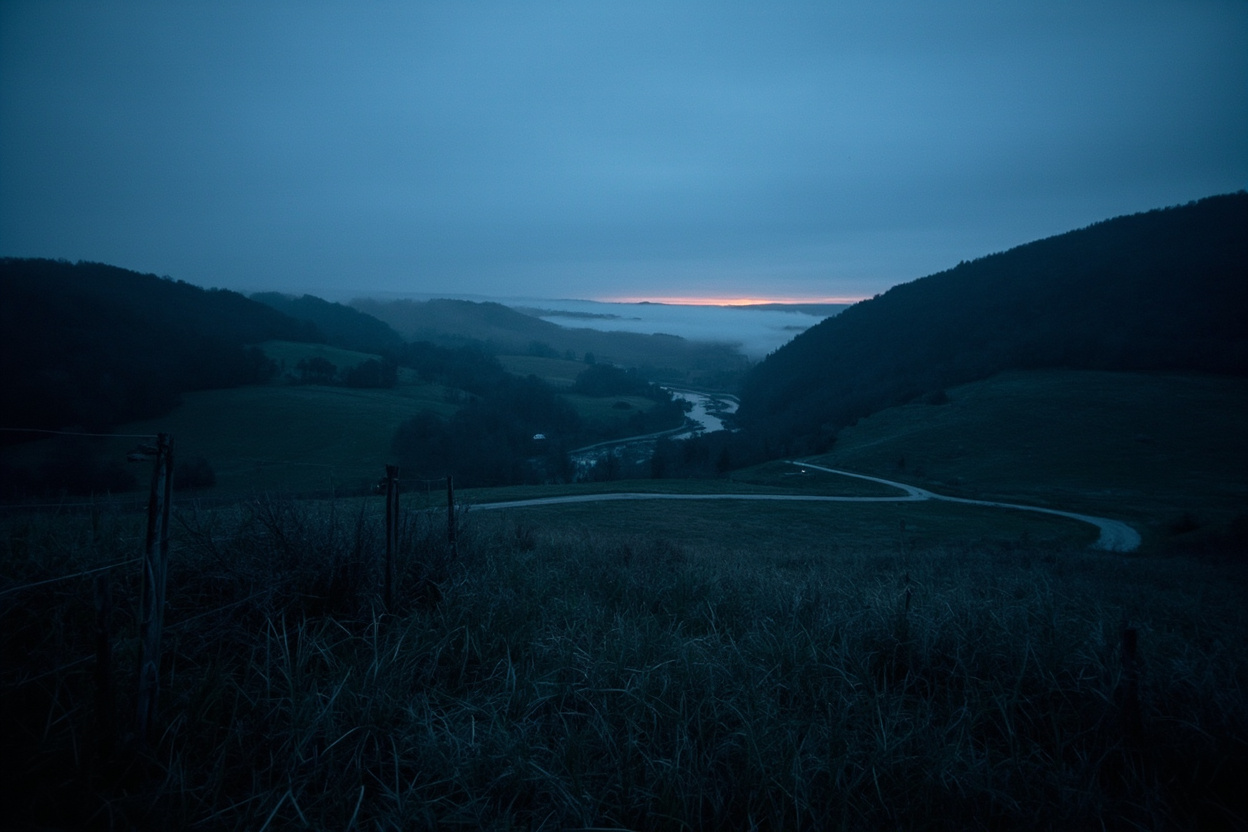
Seven Bigfoots in a Line: Kentucky's 1978 Germantown Farm Report and the Maysville Monster
This week we finally did the sweep the way it should have been done a long time ago. Instead of hitting the front page of the Bigfoot Society podcast and the latest TikTok, we pulled every single county listing on the Bigfoot Research Organization's sightings database for Indiana, Kentucky and Ohio — 300 county pages, 465 individual reports. Then we read them. The report that stopped us was filed on December 23, 1978, by a dairy farmer outside Germantown, Kentucky, who watched seven Bigfoots walk single file across his pasture ridge. It is the only Class A sighting on record claiming a group that size, and it sits eight miles outside the town where, two years later, Kentucky would get a monster of its own.
How We Did the Sweep
Most Bigfoot news coverage is a news cycle problem. Something gets posted, a podcast picks it up, and by the end of the week the story is a 90-second clip with a creator's name on it. It is genuinely hard to find a story that nobody has covered, because almost nobody reads the archives.
The BFRO database is the archive. It is also, structurally, the single most useful thing in this field and the most underused. Every report has a classification, a location, a description, an investigator follow-up, and — critically — a number. We pulled all 300 county pages for our three states and extracted every report line, which is where the 465 came from:
- 289 reports across Ohio's 88 counties
- 103 reports across Kentucky's 120 counties
- 73 reports across Indiana's 92 counties
Our own database now holds 102 sightings. Before this week it held 89, and not one of them was in Mason County, Kentucky — which is why this story is new to us and almost certainly new to you.
"Bigfoots are almost never seen or heard in groups larger than three (3) at a time. No credible witness that we know has ever claimed to see seven (7) bigfoots at once. Four (4) is the largest number of bigfoots seen in one place that I can recall off the top of my head."
— BFRO Investigator Matt Moneymaker, notes appended to BFRO Report #79768
The Report That Stopped Us
Here is the case in its own words. BFRO Report #79768, Class A, Mason County, Kentucky, dated December 23, 1978.
The witness is a dairy farmer in his late seventies. He is now in his late seventies; at the time of the sighting he was a former Marine who had fought in Vietnam, living and working less than a mile outside Germantown, near the junction of Highway 10 and Walton Pike. That is roughly 43 miles southeast of Cincinnati and a short walk from the Ohio River.
It was about 4:30 PM on a clear, sunny December afternoon. He was preparing to milk cows. Looking up, he saw them:
- Seven large, dark, upright figures
- Walking single file across a ridgeline, roughly 200 to 230 yards away
- The lead figure stopped, turned, and appeared to look directly at him while the others continued past
- After the last figure descended the hill, the first rejoined the group and all seven moved into a wooded creek area
- He started down the fence line toward them — and sixteen Holstein heifers stampeded uphill past him
- He was carrying a .41 Magnum with five rounds. He didn't shoot. He didn't pursue.
His description, offered decades later in an audio interview, is unusually flat and specific for a man of his generation and upbringing:
"They were dark — black, as far as I could tell. I didn't notice any brown or reddish tint. All seven were roughly the same size, though the one in front appeared slightly smaller than the one behind it. None stood out as significantly shorter or taller. They were spaced apart, not walking shoulder-to-shoulder.
As they started down the hill, the one in front stopped and turned its face toward me. It stood there watching while the others continued past it in single file. When the last one reached the point where only the tops of their heads and torsos were visible, that first figure turned, stepped back into line, and followed them down into the creek."
— Dairy farmer, Germantown KY — audio interview with BFRO Investigator Charlie Raymond (KBRO)
The detail that lands hardest is the cow. He was not a man who would confuse a herd of cattle for a herd of anything else — he handled them every day. Sixteen Holsteins, alarmed, moving uphill directly away from the direction the figures had just gone, is an animal response you cannot fake in a story about something imaginary. He also describes them as moving in a coordinated manner, and as uniformly dark black with no brown or reddish tint.
There's also the detail nobody highlights: no vocalizations and no smell. Most Sasquatch accounts include a roar, a scream, a howl, or a smell. These made neither sound nor odor. They walked.
Why Charlie Raymond Believes It
The report was investigated by Charlie Raymond, founder of the Kentucky Bigfoot Research Organization — arguably the most active Bigfoot investigator in the region — and it was submitted in February 2026, nearly half a century after the event.
"He is now in his late 70's. He was a Marine who fought in Vietnam. He was very reluctant to be interviewed (filmed) due to being ridiculed, however I persuaded him for an audio interview off camera. He is very sincere and highly credible in my opinion."
— BFRO Investigator Charlie Raymond, follow-up investigation on Report #79768
Raymond also lays out the case for why a 1978 sighting in this exact spot matters: it lands inside the time window and geography of the Maysville flap. Maysville is only about ten miles east of the Germantown farm. A sighting cluster in a small area over a short window is what researchers call a flap — and the Maysville flap, two years later, produced newspaper headlines and a police file.
Moneymaker's note adds the piece that turns this from a curiosity into a story: seven Bigfoots travelling together and hunting cooperatively would explain itself — northern Kentucky and southern Ohio have enormous deer herds, and cooperative hunting makes sense in exactly this habitat. He also notes that "wildman" sightings along this stretch of the Ohio River go back well over 100 years, on both the Kentucky and Ohio sides.
Two Years Later: The Maysville Monster
The Maysville Monster flap is the one that made the newspapers, and it is the reason the 1978 farm report is important. Two encounters, both Class A, both still in the BFRO database, both inside five weeks of each other.
October 7, 1980 — Mayslick: The Rooster and the Pink Eyes
BFRO Report #2425. A family in Mayslick was watching television when they heard a loud noise on the front porch and their son's pet rooster being disturbed. The witness, C.F., opened the front door and saw a white, hairy creature with pink eyes, estimated at roughly 7 feet tall and about 400 pounds, holding the rooster by the neck.
Then it hurled the rooster against the side of the house and moved around the back. C.F. grabbed a .22 pistol and fired twice as it ran off. He described the hair as real long, "much like a horse's mane," the eyes as animal-like on an otherwise man-like face, and the gait as large-strided but unhurried — the faster he ran, the further away it stayed, "like a dream."
Investigators Ron Schaffner and Earl Jones reached the case after a small Cincinnati Enquirer article ran, traced it through a local Maysville newspaper to radio newsman Doug McGill at WFTM, and interviewed C.F. on October 12, 1980. They spent hours in the surrounding terrain and found no tracks, scat, or hair.
Their note is worth reading for how researchers actually work: close scrutiny of the rooster showed no sign of physical injury, and it would be difficult to believe the bird could have survived being projected against the house by something of that size. A raccoon found on the roof later that night had been locked in a cage earlier that day. The investigators did not dismiss the account, but they documented every loose end, including the fact that it was the press — not the witness — that first used the word "bigfoot."
November 5, 1980 — U.S. 68: The Truck Driver Who Thought It Was a Hitchhiker
BFRO Report #2426. At 4:00 or 5:00 AM on US 68 west of Maysville, an Alabama truck driver hauling steel saw a figure on the opposite side of the highway. He slowed and hit his high beams, assuming a hitchhiker. Then:
"When he approached the figure, he was shocked to see a 6-7 foot tall 'ape-like' creature with white hair.
This incident is on file with the Maysville, Kentucky police department. We consider it to be valid. We cannot comment any conclusions because no researcher interviewed the witness."
— BFRO Report #2426 — Investigators Doug McGill (WFTM) and Dave Jones (Maysville police detective)
What makes this one unusual is the witness's ignorance of the topic. He had never been to Kentucky before and knew nothing about alleged Bigfoot reports. After the encounter he went to local drivers on CB channel 22 asking whether a zoo or circus was in the area, because he genuinely thought he might have seen an escaped ape. The Maysville police took his statement, filed a report, and noted they believed he was serious. He had heard about previous reports from other CB users — which tells you the story was already circulating along that corridor before the police file.
The Flap That Never Really Ended
Raymond's notes list what came after, and it is worth reading because it shows this isn't a closed 1980 story:
- Late 2002 into early 2003 — four witnesses, night, on KY 435 and Clyde T. Barbour Highway; a 6-to-7-foot figure with black, long, wet hair
- Summer 2006 — two witnesses on US 62, 4:00 PM; dark brown to black and bulky, 7.5 to 8 feet tall
- May 2021 — Class A daylight sighting by a hunter 30 miles southeast of Louisville, in Anderson County
- October 2018 — a Lawrence County farming family 12.5 miles south of Grayson, on Bells Trace Road: knocking on trees, slapping the side of the house, footsteps and growling right outside the door, a branch landing on the back porch, and an outside dog that stopped leaving the porch after dark
- September 18, 2026 — the monthly Anderson County Bigfoot Hunt out of Lawrenceburg, run by KYGhostTours
Add the two we dug up that are stronger still. In June 2008, BFRO Investigator Pam Lovins — a West Virginia investigator who was closest to the site and got called in — took two witnesses up a rocky ridge in the Daniel Boone National Forest near Cave Run Lake with a Sony nite-shot infrared camcorder and gen-3 night vision goggles. Her red headlamp caught a sasquatch standing motionless between two trees, 15 to 20 feet below the rock formation, which then pulled back into the shadows and walked away. A second witness simultaneously called out "eyeballs" and filmed separate eyeshine in the opposite direction. Two animals, one of which was never seen directly by anyone. Footfalls followed the group down the hill.
And in December 2006 on Pine Mountain in Harlan County, a deer hunter wearing a ghillie suit and scent-lock clothes — dragging a rag soaked in deer urine behind him — was checked out by two Sasquatches. One was about 7 feet, the second roughly 2 feet smaller. The smaller one threw a two-foot stick past him; the larger one, crouched 50 yards away with another stick in hand, dropped into what the investigator called a "football stance" and charged. He fired in front of it, it stopped, retreated, and called the smaller one with a low guttural grunt; the small one came out wailing in a high-pitched, half-woman-scream-and-half-baby-crying manner. The next day his backpack was torn open, his food eaten and his drink cans burst — but his knife and Game Boy were left where they were.
Why the Ohio River Is the Line
Look at where all of this sits on a map. Germantown. Mayslick. Maysville. Lawrenceburg. Anderson County. Harlan County and Pine Mountain. Rowan County and Cave Run Lake. They are strung along the Ohio River corridor and the long ridge systems that run off it — the same land that makes the Daniel Boone National Forest what it is.
This is not a coincidence of database geography, and the BFRO investigators say so directly. In the Carroll County, Ohio report investigated by James Thompson, Moneymaker appends an observation worth repeating here:
"Sightings in non-mountainous parts of the country tend to happen within a few miles of certain landmarks, as if bigfoots follow these landmarks for long distances. There is a pattern of sightings close to creeks, rivers, electrical power tower pathways, gas line routes, and railroad beds."
— BFRO Investigator Matt Moneymaker, notes appended to BFRO Report #76924 (Carroll County, Ohio)
The Ohio River is the ultimate such landmark. It is a water corridor, a railroad corridor, a highway corridor, a wildlife corridor, and a ridgeline separator all at once. A corridor that a large primate could move along for a hundred miles without ever crossing a road a human would notice.
And note the timing across these reports. The 1978 Germantown sighting is December 23. The Maysville encounters are October 7 and November 5. The Harlan County encounter is December 9. The Daniel Boone National Forest encounter is June. If there is a season here — and there is a real argument for late autumn and early winter, when the leafless hardwoods strip visibility and the deer are concentrated and the animals are moving downslope toward the river — this corridor produces it every year.
What We'd Want to See Next
If this story is real, and if the Maysville corridor has been carrying traffic since at least 1978, then three things would move it from "remarkable anecdote" to "unignorable."
A track survey of the Germantown ridge line and the creek below it. That is a specific, walkable piece of ground. A plaster cast of whatever walked that ridgeline in December 1978 would still be in that soil in some form, and the creek bottom is exactly the substrate that holds prints. Anyone with a pair of boots and a casting kit could check.
The Maysville police file from 1980. The BFRO note says the incident "is on file with the Maysville, Kentucky police department." That is a document that should exist, and a newspaper clipping that should be in a Mason County microfilm archive somewhere. If the Enquirer ran it, somebody has it.
The other witnesses on this corridor, still living. The 2002–03 Kentucky 435 sighting, the summer 2006 US 62 sighting, the Anderson County hunter from 2021. Charlie Raymond has been calling people back and getting statements from men in their seventies and eighties who never told anyone. That pipeline is not exhausted. If there is a person alive who saw what that Kentucky dairy farmer saw, they are probably in Mason, Lewis, or Fleming county right now, and they are probably still embarrassed about it.
One more thing, for the calendar: Cryptid Con 2026 runs November 21–22 at the Belterra Casino Resort in Florence, Indiana — Bigfoot, monsters and legends, an hour up the road from this corridor, in the state that keeps producing these reports. If you want to be in a room with the people who are still chasing this, that's the closest one to you.
Sources:
• BFRO Report #79768 (Class A) — Mason County, Kentucky; event Dec 23, 1978; seven Bigfoots on a dairy farm near Germantown; investigated by Charlie Raymond (KBRO), notes by Matt Moneymaker; submitted Feb 8, 2026
• BFRO Report #2425 (Class A) — Mayslick, Mason County, Kentucky; event Oct 7, 1980; white creature with pink eyes, rooster thrown against the house; investigated by Ron Schaffner and Earl Jones
• BFRO Report #2426 (Class A) — U.S. 68 west of Maysville, Kentucky; event Nov 5, 1980; truck driver sighting; on file with the Maysville police department; investigators Doug McGill (WFTM) and Dave Jones
• BFRO — Mason County, Kentucky: Reports & Articles index
• BFRO Report #24674 (Class A) — Daniel Boone National Forest, Rowan County, Kentucky; event June 14, 2008; BFRO Investigator Pam Lovins' filmed encounter at Cave Run Lake
• BFRO Report #40278 (Class A) — Pine Mountain, Harlan County, Kentucky; event Dec 9, 2006; ghillie-suit hunter and the two Sasquatches; investigated by Jack Smarr
• BFRO Report #1024 (Class A) — Casey County, Kentucky; event October 1953; Bigfoot tool use; investigated by Kevin Withers
• BFRO Report #878 (Class A) — Highbanks Metro Park, Delaware County, Ohio; event August 1989; white Bigfoot
• BFRO Report #65305 (Class B) — Egypt Valley, Belmont County, Ohio; event April 7, 2020; bipedal footfalls and tree pushover; investigated by James Thompson
• BFRO Report #76924 (Class A) — Carroll County, Ohio; event Feb 6, 2024; road crossing near Perrysville; investigated by James Thompson
• BFRO Report #77058 (Class B) — Butler County, Ohio; event March 5, 2024; howls and chatter near Hamilton; investigated by Kathy Harrahill
• BFRO Report #60871 (Class A) — Martin County, Indiana; event March 2018; creature crossing a property near Loogootee; investigated by Chuck Shutters
• BFRO Report #65589 (Class B) — Washington County, Indiana; event June 12, 2020; knocks on Spurgeon Hollow Trail
• BFRO Report #61108 (Class B) — Lawrence County, Kentucky; event Oct 20, 2018; activity around a rural family home; investigated by Jack Smarr
• BFRO — Kentucky: all reports, 118 listings
• BFRO — Ohio: all reports, 333 listings
• BFRO — Indiana: all reports, 82 listings
• BFRO — Explanation of the report classification system (Class A / B definitions)
• "Dairy Farmer Saw SEVEN Bigfoots In Northern Kentucky" — walkthrough of the Germantown report and the Maysville encounters
• Cryptid Con 2026 — Belterra Casino Resort, 777 Belterra Drive, Florence, Indiana; November 21–22, 2026
• BFRO Group — "Multiple bigfoot sighting in Maysville, KY" (Maysville Monster flap and the White Bigfoot of Kentucky case)
Live near the Ohio River in Mason, Lewis, Fleming, Campbell or Gallatin County? Submit your sighting →
🎬 Watch the TikTok promo for this post: