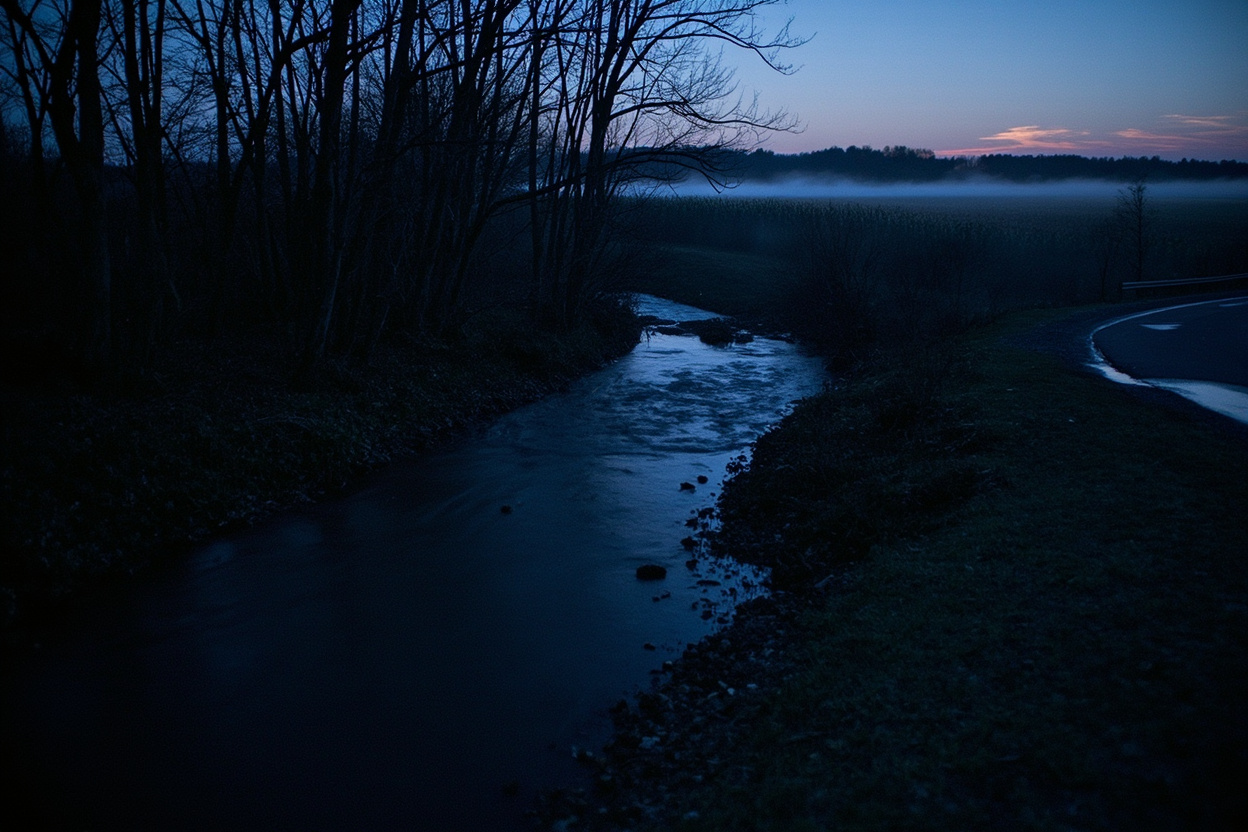
Three Indiana Bigfoot Reports in One Week: Crawford County Creek Crossing, Scott County Tracks, Owen County Booms
In five days, the Indiana Bigfoot Research Organization published three new county sighting reports — and exactly one of them happened this month. The Crawford County entry is the strongest: a Class A visual, late afternoon, a solid black figure estimated at seven to eight feet wading across a creek while the witness watched from a public road. The Scott County entry is a bow hunter's track photograph, scaled with a crossbow arrow, still sitting in review. The Owen County entry describes a fishing trip where something chuffed, boomed three times, snapped branches overhead, and left two prints — two years ago. That reporting lag is the part worth understanding, because it's the norm, not the exception.
The Creek Crossing: Crawford County, Class A
The Crawford County report is the one that would make any researcher sit up. The witness's entire account, published by IBRO on October 16, runs eight words of description before you get to the classification field:
"Saw it from the road wading across a River."
— Indiana Bigfoot Reports, Crawford County sighting (event date Nov 1, 2025; published Oct 16, 2026)
What makes it a Class A rather than a vague roadside impression is the detail the witness volunteered unprompted. IBRO's intake form logged the sighting as black, 7–8 feet, taken at 4:30 in the afternoon, at a creek or river, with a contact time of less than five seconds. The physical description field reads: "Saw profile. Thick chest from front to back, Tall long arms."
That "thick chest from front to back" line is doing more work than it looks like. It's the standard way witnesses describe a deep torso — the barrel-chested, front-to-back depth profile that distinguishes a large primate silhouette from a human in a bulky coat. Combined with long arms and a river crossing at four-thirty in the afternoon — full daylight, not a spotlight, not a blur — it's about as clean a Class A Indiana has logged in a while.
And then it was gone. Under five seconds, off the far bank, no photograph, no tracks recovered afterward. Crawford County sits along the Ohio River in southern Indiana, a county of narrow creek-bottom timber, steep wooded ridges, and old-growth sycamore along the water. The kind of ground where something can cross a creek in daylight and be gone before you can safely stop the truck.
The Track Photo: Scott County, Under Review
Two days after the Crawford County post, IBRO published a Scott County report dated October 11, 2026 — this month's actual event. A bow hunter working private timberland found what he believes to be a Bigfoot print and photographed it with a crossbow arrow laid alongside for scale.
That's a genuinely good instinct from the witness. Scaling a track with a known-length object is exactly the right field practice, and it's why this one is worth following even though it hasn't been classified. IBRO's status on it reads simply: Pending Review.
What happens next matters. A hoofed-tracked ungulate print scaled with an arrow can still be ambiguous at a glance, and Scott County sits in the bluegrass-to-timber transition of southern Indiana where deer and turkey density are high. Print verification in the field almost always requires the dermal ridge detail — those fine striations on the pad and toe pads that only show on a clean cast in moist soil. A photograph may not resolve them. A cast will.
Until the review closes, this one is exactly what it says on the tin: unverified. We've added it to the Heartland Bigfoot tracker as a Tracks sighting with that caveat intact.
The Booms: Owen County, Two Years Late
The Owen County report is the one that should give researchers the most to chew on, and it's also the one where the delay is largest. Published October 17, it describes an event from June 24, 2024 — a gap of roughly twenty-eight months.
A woman and her father were fishing from a bridge on a private lake at 7:00 PM. They heard a loud chuffing bark, then three deep booms. The witness's account:
"Fishing on a private lake, me and my Father heard a loud chuffing bark like sound and then 3 loud booms. It sounded like something was either stomping or wood was being hit, either way it was a very deep sound. It repeated the actions with the chuffing and then 3 other loud booms, it then proceeded to run away through the woods."
— Indiana Bigfoot Reports, Owen County sighting (event date June 24, 2024; published Oct 17, 2026)
Two things make this more than a sound-at-night report. The first is the repetition — the chuff-and-three-boom sequence happened twice, roughly a minute apart, which is the behavioral signature of an animal responding to a stimulus rather than one that was merely walking.
The second is the physical evidence, and it's quantified. IBRO logged snapped twigs at roughly two feet above the witness's head while she was standing on the bridge — and she put her own height at 5'9", putting the broken branches at about 7'9". Along with two prints, the witness included a photo with her women's size 11 shoe for reference, noting the tracks were substantially larger.
IBRO classified it Class B — Possible / Circumstantial Encounter, on the basis that the creature was heard but never seen. That classification is doing careful work: the witness did not claim to see anything. She claimed to hear something, and then found physical signs of something large moving through timber overhead.
Why the Delay? The Reporting Lag Nobody Accounts For
Here's the thing the Crawford County and Owen County reports make obvious: two of this week's three Indiana sightings happened in prior years. One is twenty months old. One is twenty-eight months old. The Crawford County event happened in November 2025 — nearly a full year before it was published.
That isn't a failure of the reporting system. It's the system working the way it's always worked.
Cryptid witnessing carries a social cost that almost nothing else does. Tell people you saw deer moving unusually. Nobody cares. Tell people you found a track that might be a primate — and now you're the guy with the Bigfoot story at the deer stand, at the VFW hall, at the school pickup line. The Crawford County witness waited eleven months. The Owen County witness waited two and a third years. The IBRO intake form is asking for something most people don't want to say out loud.
Researchers have known this for decades. It's why BFRO's own database state listings show a strange pattern when you read them carefully — the Kentucky listing, for example, still carries reports filed in October 2021, and county entries across Indiana routinely list a "most recent report" year that trails the "last posted" date by a decade or more. The lag is baked into the data.
"Most of the reports on the database come from witnesses who submit them directly to the BFRO via the Internet. The remaining body of second-, third-, and [later-hand reports come from published accounts and media]."
— BFRO — Reports for Ohio (state listing methodology)
The practical consequence is that any monthly sweep of heartland Bigfoot reports will systematically undercount what just happened. The activity is current. The paperwork is not. A report published in October 2026 is not a sighting from October 2026 — it's a sighting someone finally decided was worth saying out loud.
What These Three Have in Common
Set them side by side and a pattern shows up that the individual reports don't reveal.
Every one of them is a water or lowland report. Crawford County: a creek. Owen County: a lake. Scott County: private timberland in the bluegrass-to-timber transition. That tracks the pattern we've been seeing across the rest of the heartland data — the Lawrenceburg and Hodgenville Kentucky reports, the Whitewater River corridor in Fayette County, the Breathitt County campsite. Sasquatch reports in Indiana, Kentucky, and Ohio cluster along riparian corridors: creek bottoms, river edges, and the flat timber that follows them.
All three are witness-initiated, not investigator-found. Nobody stumbled onto the Crawford County figure. Nobody found the Owen County tracks on a scheduled search. These came in because somebody decided to describe what they saw. That's a meaningful signal: the reporting network is catching events on private land, at dusk, on weekdays — the exact times and places that no organized expedition will ever be standing.
And all three got documented with a scale reference. The crossbow arrow in Scott County. The size 11 shoe in Owen County. The five-second duration and height estimate in Crawford County. Whether or not these turn out to be primate, witnesses are instinctively describing them the way they'd describe any piece of physical evidence — measured against something known. That's good witness practice, and it's why these reports will hold up better than most.
The Part That Should Worry a Skeptic — Fairly
We owe this section to the readers who are here to be argued at, not sold to.
The Crawford County sighting lasted under five seconds, in fading afternoon light, at roughly road distance, from a moving vehicle, with no photograph and no corroborating physical evidence. That is a Class A by BFRO's own criteria — a witness who claims to have seen something — but it is a Class A that rests entirely on the accuracy of one person's memory of one glimpse. Black bear, escaped emu, and large deer all produce silhouette reports exactly like this, and the Crawford County witness's own description — "thick chest from front to back, tall long arms" — is notably vaguer about the head and face than the Kentucky cases BFRO investigators have investigated in person.
The Owen County case is stronger on evidence and weaker on observation: real broken branches at 7'9" and real oversized tracks, but no eyes on the animal. Bears break branches. Bears leave large tracks. Bears make chuffing sounds and heavy booms when agitated near a person. Nothing in that report is impossible without a sasquatch.
The Scott County track is the one that will actually resolve something one way or the other, and that's exactly why it's marked Pending Review rather than quietly filed as a hit. Watch for the classification.
We're not going to pretend a twenty-month-old Class A glimpsed from a road settles anything. What it does is add a data point to a pattern that keeps showing up in the same terrain — creek bottoms and river timber in southern Indiana, running south into Kentucky and west into the Ohio River hill country. The pattern is the evidence. The individual sightings are just how we find out where it is.
Where to Watch From Here
Three things worth tracking into November.
First, the Scott County review. If IBRO's classification comes back positive, it would be the first verified track evidence logged in Indiana from 2026 — and it would move from a photograph to a cast, which is a completely different evidentiary category.
Second, Crawford County. A Class A visual in daylight is the kind of report that tends to generate a second witness within a few weeks if it's real. If another motorist on that same stretch of road has seen the same profile and hasn't called in yet, the story gets considerably stronger.
Third — and this is the one nobody tracks, which is exactly the point. Somewhere in Indiana right now, somebody knows what they saw at a creek or a lake or a treeline, and they're not telling anyone. The Owen County witness sat on that for twenty-eight months. The Crawford County witness sat on it for nearly a year. There are probably a dozen more sitting on theirs right now.
That's the real number nobody can measure. And it's why the Crawford County report — a five-second glimpse of something black crossing water in the late afternoon — is the one we'll be thinking about.
Sources:
• Indiana Bigfoot Reports — Crawford County sighting (Class A; event Nov 1, 2025; published Oct 16, 2026)
• Indiana Bigfoot Reports — Scott County sighting (Pending Review; event Oct 11, 2026; published Oct 12, 2026)
• Indiana Bigfoot Reports — Owen County sighting (Class B; event June 24, 2024; published Oct 17, 2026)
• Indiana Bigfoot Reports — Indiana report index (posting dates for the Oct 12/16/17 cycle)
• Indiana Bigfoot Research Organization — organization overview
• BFRO — Reports for Indiana (county listings and "last posted" lag)
• BFRO — Reports for Kentucky (county listings and reporting-lag comparison)
• BFRO — Explanation of the report classification system (Class A / B definitions)
Fished a creek, walked timber, or driven a back road in Crawford, Scott, or Owen County? Submit your sighting →
🎬 Watch the TikTok promo for this post: