The Government Investigated Bigfoot in 1982 — and Its Own Biologist Called It a Hoax
On October 15, 2026, the U.S. Forest Service quietly posted three files to its FOIA reading room under a heading that reads like a punchline: "Bigfoot/Sasquatch Records." The Washington Post got there first and ran it as Bigfoot believers get a boost from an unlikely ally: The U.S. Forest Service. Fox News, the New York Post, and every local TV station in Washington State followed. One of the three files is a six-page internal memo from June 18, 1982, in which a U.S. Forest Service wildlife biologist named Rodney L. Johnson documents a government Bigfoot track investigation in the Mill Creek Watershed of Washington's Umatilla National Forest — photographs, plaster casts, measurements, and a written conclusion. We pulled the PDF, rendered every scanned page, and read the whole thing. Johnson was not fooled for a second. He also documented exactly how the hoax was pulled off, which is the genuinely interesting part of this story.
What Actually Got Released
Three PDFs, filed under Region 4 (Intermountain Region) of the National Forest System's FOIA reading room, all dated October 15, 2026:
- "June 18 1982 Bigfoot Tracks Investigation Umatilla NF.pdf" (553 KB) — the memo that started all of this: Johnson's six-page field report, with photographs of the tracks, plaster casts, and his conclusions.
- "Clark Fork Valley Press Article JAN 13 2003.pdf" (374 KB) — a January 13, 2003 newspaper article about a large track sighting near Plains, Montana.
- "Kinney_whatdoyouknow_MT.pdf" (492 KB) — a typed retelling by Leo Kinney of a Bigfoot encounter on Petty Creek, Montana, in the 1940s, written down in 1980.
There is also a fourth piece floating around in the coverage: a "Bigfoot in Your Backyard" forum that U.S. Forest Service staff hosted in California's Stanislaus National Forest, where the agency's stated position was that it could neither confirm nor deny the creature's existence. That one is the reason the Washington Post wrote that believers had found "an unlikely ally." The files themselves are a much more mixed bag.
June 17, 1982: Three Days in the Low Creek Drainage
The memo's letterhead puts it at Umatilla National Forest, Pendleton, Oregon, stamped "JUN 18 1982." The subject line reads: "Documentation of Investigation into Sighting of 'Bigfoot' Tracks in the Mill Creek Watershed." It's addressed to Roger E. Baker, Resource Staff, and the timeline is tight:
On June 16, Baker asked Johnson to accompany a group into the Mill Creek Watershed the next day "to investigate a reported find of 'Bigfoot' tracks in the Low Creek drainage." On June 17, the team went in. On June 18, Johnson filed his memo. The Mill Creek is a 36.5-mile tributary of the Walla Walla River, and the Umatilla straddles the southern Washington border and north-central Oregon — the heart of Bigfoot country, which is why the tracks landed on a biologist's desk in the first place.
Three sites had been reported:
Site "A" — the Low Ridge Trail
Directly on the Low Ridge Trail about 1.5 miles above Mill Creek: six identifiable tracks extending down the trail roughly 25 feet through quite muddy trail bordered by dense vegetation. The tracking expert with the group found no other track evidence beyond what was already in the trail mud. Plaster casts were made of two tracks — the rest were too faint to show anything of value. Color photographs were taken.
The photo captions are where the measurements live. Photograph #2 shows Site A, Track #4, "a right foot approximately 15 inches long and 7 inches wide at the widest point" — with the note that "the heel portion of the track was destroyed by an elk track during the night." Photograph #3 shows Track #5, "a left foot track approximately 15 inches by 6.5 inches," with a "deformation of 2nd toe (next to 'big toe')."
Site "B" — the elk wallow
Adjacent to a bog — an elk wallow — next to the Low Creek Trail about 2.75 miles above Mill Creek: approximately 18 prints over roughly 40 feet. The tracks began in soft mud at the bog, ran up over a small rise, down the other side, and into dense herbaceous vegetation, with "sign of disturbance to this vegetation for another 30-40 feet indicating passage of something." Two more casts were made. In photograph #7, a watershed rider's boot sits next to the track for scale.
Site "C" — never visited
And here's the detail that tells you how Johnson was thinking from the start: the group never went to Site C. "Reasons for this were the time of day and the conclusions reached at Site 'B,'" he wrote. Site C was a dry open area with about 12 individual tracks as described by the watershed rider known as Epoch — and Johnson noted, drily, that the general description "appears very close to that observed at sites 'A' and 'B.'" He didn't need to walk to the third site. The first two were already enough.
The Conclusion: Eight Reasons It Wasn't a Sasquatch
Johnson's findings section is the part that has circulated most widely, and it's worth reading closely — not because it proves anything about Bigfoot, but because it's a master class in how a trained biologist tears apart a physical evidence claim:
- The stride didn't change with the slope. Every track showed a stride of "right at four (4') feet" — on a 2.25% grade at Site A and an 8.25% grade at Site B. A two-legged animal's stride shortens uphill and lengthens downhill. This one didn't budge.
- The tracks weren't at the bottom of the mud. "In fact, we were sinking in deeper with boots at the same locations." A 300-plus-pound foot should have punched deeper than a man's boot, not less.
- The tracks were isolated — with a definite beginning and an end. Johnson compared them to the many bear trails the team observed, which "trickle" very easily and can be followed. These just started and stopped.
- The toeprinting was too clean. It was "very clear on the portions of the feet that should be worn smooth and calloused," with none of the creases you'd expect on a genuinely calloused foot.
- The pine litter had been brushed aside before the track was made — "displaced sideways from the track area in an unnatural manner."
- The small toes lacked a definite pad at the tip, which Johnson considered "very evident on a track of this size if the foot points forward and the toes tend to 'grip' and push off."
- No toe slippage on the steep gradient — for an animal of the reported size, on that grade, in wet mud, there should have been slippage backward uphill and forward downhill. There wasn't.
- The foot looked "rocked" from side to side. Toes appeared wider on some tracks than others, the print marks extended up the side of the foot, and the inside of the arch was compressed far more than a normal stride allows.
Then the line that made the newspapers, and the most honest sentence in the file:
"If the tracks were faked, someone went to a great deal of trouble and detail. The 'print' marks on the foot would have to be very hard to duplicate. They appear very natural. I would almost suspect a cast made of an actual foot would have had to be used to make the 'fake' feet. If this were the case though, the other creases in the foot should have shown."
— Rodney L. Johnson, Wildlife Biologist (North Zone), Umatilla National Forest, June 18, 1982
Johnson's written conclusion was that the tracks at Sites A and B "were made by something other than a" several-hundred-pound-plus "two footed being." (The exact weight figure is partly obscured by a stamp in the scanned original; the press has published it variously as 300 and 500 pounds.) He closed the letter by saying he had given "the negatives for the attached photographs to the District as well as the plaster casts."
Six Weeks Later, a Border Patrol Memo
On July 28, 1982, a second federal memo was written — this one from a U.S. Forest Service official to the District Supervisor of the Walla Walla District, U.S. Border Patrol. It is, if anything, blunter:
"My opinion is that the tracks were a very clever attempt to demonstrate a hoax, involving your office or agency, in order to lend authenticity or credibility to the general public."
— U.S. Forest Service, to Walla Walla District Supervisor, U.S. Border Patrol, July 28, 1982
The memo notes that the tracks at both sites were "identical in appearance, size, and individual characteristics," and therefore had to have been made by the same "Bigfoot" — the same reasoning Johnson's own notes implied. The official's conclusion was that the tracks "were made by using some type of soft plaster or rubber coated" material, and that they failed to push down to solid matter even under the heel and ball of the foot, ran dead straight "in line," showed an exact stride uphill and downhill on an irregular trail, and appeared and disappeared on the trail with nothing leading in or out.
And then the sting, in the closing paragraph:
"Who made the tracks — my opinion, someone with normal access to the area, very knowledgeable and interested in 'Bigfoot' legends and stories; a person large enough to imitate the track device sufficiently to make the sign described and of which you have the evidence."
— U.S. Forest Service, July 28, 1982
Read that again. The government wasn't just saying "no." It was saying someone local, someone who knew the folklore, had deliberately staged physical evidence at a federal investigator to make it look legitimate. That's the part of this file that ought to stick with you — and it's also the part the Washington Post's "unlikely ally" headline leaves out entirely.
The Other Two Files: Montana, 1940s and 2003
The Washington files are a hoax with a paper trail. The Montana files are something else — they're the actual folklore, and they're the reason this release is worth a national story.
Leo Kinney's account (written down in 1980, describing the 1940s) is the best thing in the release. Kinney and three other hunters went into the woods near Petty Creek, a tributary of the Clark Fork River west of Missoula, to pack out a six-point bull elk they'd shot. They found the entrails only. And in the snow, leading to and away from the carcass, "a large set of tracks." At first they assumed a bear — until they noticed the tracks appeared in sets of two, and bears don't walk on their hind legs.
"Whatever it was had picked up the elk whole and clear off the ground."
— Leo Kinney, 1980, recounting the 1940s
They followed the tracks about a half-mile and found a felled log three feet in diameter with the elk's horn drags scored across the snow and over the timber. And then the part that ended the expedition: "At this point we held a conference and decided that we were not particularly anxious to catch up to whatever it was, and though we didn't confess it at this time, in later conversations we found out that we all had a very uneasy feeling and could feel chills running up and down our backs." The following year another hunter, W.W. Schmitz, found the same type of tracks near Bills Creek, smelled a strong odor, and heard grunting noises.
The January 13, 2003 Clark Fork Valley Press clipping is the modern version of the same story. Around January 3, 2003, hundreds of large human-like footprints appeared in fresh snow outside Jim Rohweder's sawmill shop in Plains, Montana. Neighbor Bob Mesing measured them at 16.5 inches long and 8.5 inches wide, with visible toes, an arch, and a stride spanning about five feet. Mesing and former Kalispell policeman Dean Peterson followed the tracks about 100 yards into the woods, where the trail faded.
"I don't know if I believe in the Bigfoot theory, but the tracks were right there. What else could it be?"
— Bob Mesing, as quoted in the Clark Fork Valley Press, January 13, 2003
The men never contacted authorities. Peterson's dog had barked around 3:40 that morning, and he saw nothing. Rohweder's wife Gladys claimed to have seen a hairy, two-legged creature when the couple first moved to the area.
Why This Matters in the Heartland
Two reasons, and the second one is the whole point of this site.
First: the Forest Service gave the public its reasoning, not just its conclusion. Most agencies write a one-paragraph press release. Johnson wrote eight numbered findings and explained his reasoning, and a second federal office wrote a follow-up six weeks later. That's a document anyone can check, argue with, and use. It's the opposite of a press release. Whatever you think about Bigfoot, that's how a government agency is supposed to handle an extraordinary claim.
Second: the 1982 case is a clean template for what a good Bigfoot hoax looks like — and it is not the same thing as a good sighting. Someone with local access, deep familiarity with the folklore, and enough craft to cast a real foot and walk it in mud without disturbing the forest litter left a biologist with a nearly perfect track. He still got caught, because a 300-pound animal does not walk with a constant four-foot stride up a 2.25% grade and then the same four-foot stride down an 8.25% one.
Now apply that standard to our own region, which has its own famous old cases — the 1980 West Mansfield flap in Logan County, Ohio; the 1978 Germantown farm report in Mason County, Kentucky, where a farmer reported seven Bigfoots walking single file; and the 1974 Mill Race Monster panic out of Columbus, Indiana. Those cases don't have plaster casts. They have witnesses, descriptions, and locations that a BFRO investigator can still go check.
Which is the real lesson of the 1982 memo, and it cuts both ways: the Forest Service investigated Bigfoot tracks for a full day, photographed them, cast them, and concluded someone had staged them. Nobody has ever brought us a sasquatch. Not in 1982, not in 2003, and not yet. Until that changes, the honest position is the one a federal wildlife biologist signed his name to in June 1982: measure carefully, document everything, and don't be impressed by a footprint.
That said — and Derrick will appreciate this — the reason these files went viral is that the human stories in them are irreplaceable. Leo Kinney and three hunters standing in a Montana creek in the 1940s, deciding they'd rather not find out what was ahead of them. Bob Mesing in 2003 measuring a stranger's footprints in the snow outside a sawmill and going to look anyway. The tracks were probably faked. The people were not.
Watch the Promo
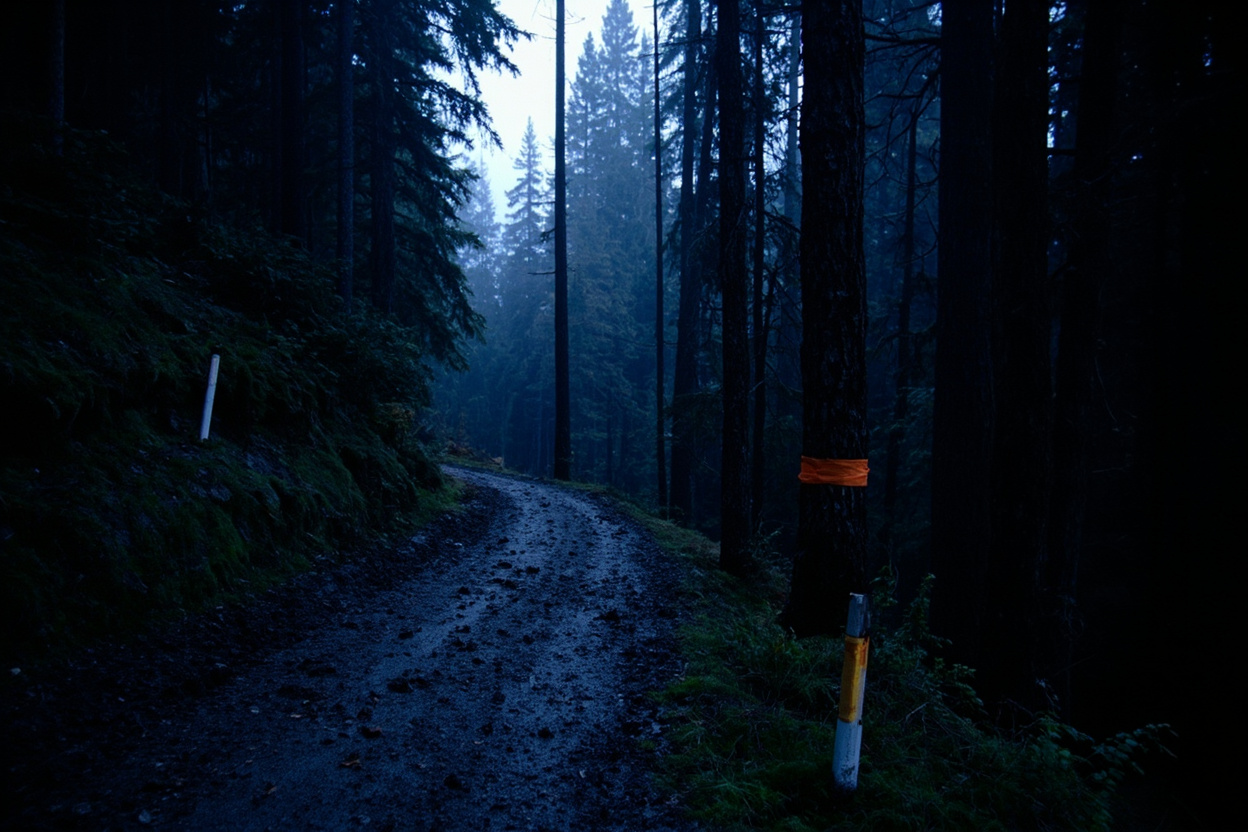
We built a short TikTok promo for this one — a muddy trail at blue hour, orange survey flagging in the trees, and the cast sitting on a field table where a biologist left it in June 1982. Watch it below, and if you've ever found tracks like these in Indiana, Kentucky or Ohio, tell us about it.
Seen something in Indiana, Kentucky, or Ohio? Submit your sighting →
Sources:
• Primary source — "June 18 1982 Bigfoot Tracks Investigation Umatilla NF.pdf" (USFS FOIA Reading Room, released Oct 15, 2026)
• Primary source — "Kinney_whatdoyouknow_MT.pdf" (Leo Kinney account, written 1980)
• Primary source — "Clark Fork Valley Press Article JAN 13 2003.pdf" (Plains, Montana tracks)
• U.S. Forest Service — FOIA Reading Room (where all three files were posted Oct 15, 2026)
• Fox News — USDA releases decades of Bigfoot files, including 1982 Forest Service investigation in Washington state (Nov 20, 2026)
• The Washington Post — Bigfoot believers get a boost from an unlikely ally: The U.S. Forest Service (Nov 20, 2026)
• New York Post — Trump admin quietly releases government Bigfoot files
• Outside Online — The Forest Service Just Released Bigfoot Records Dating Back to the 1940s (Nov 20, 2026)
• KPTV / Northwest News Network — Bigfoot files quietly released by US Forest Service
• KING 5 — US Forest Service releases records on 1982 'Bigfoot' tracks found in Mill Creek watershed